
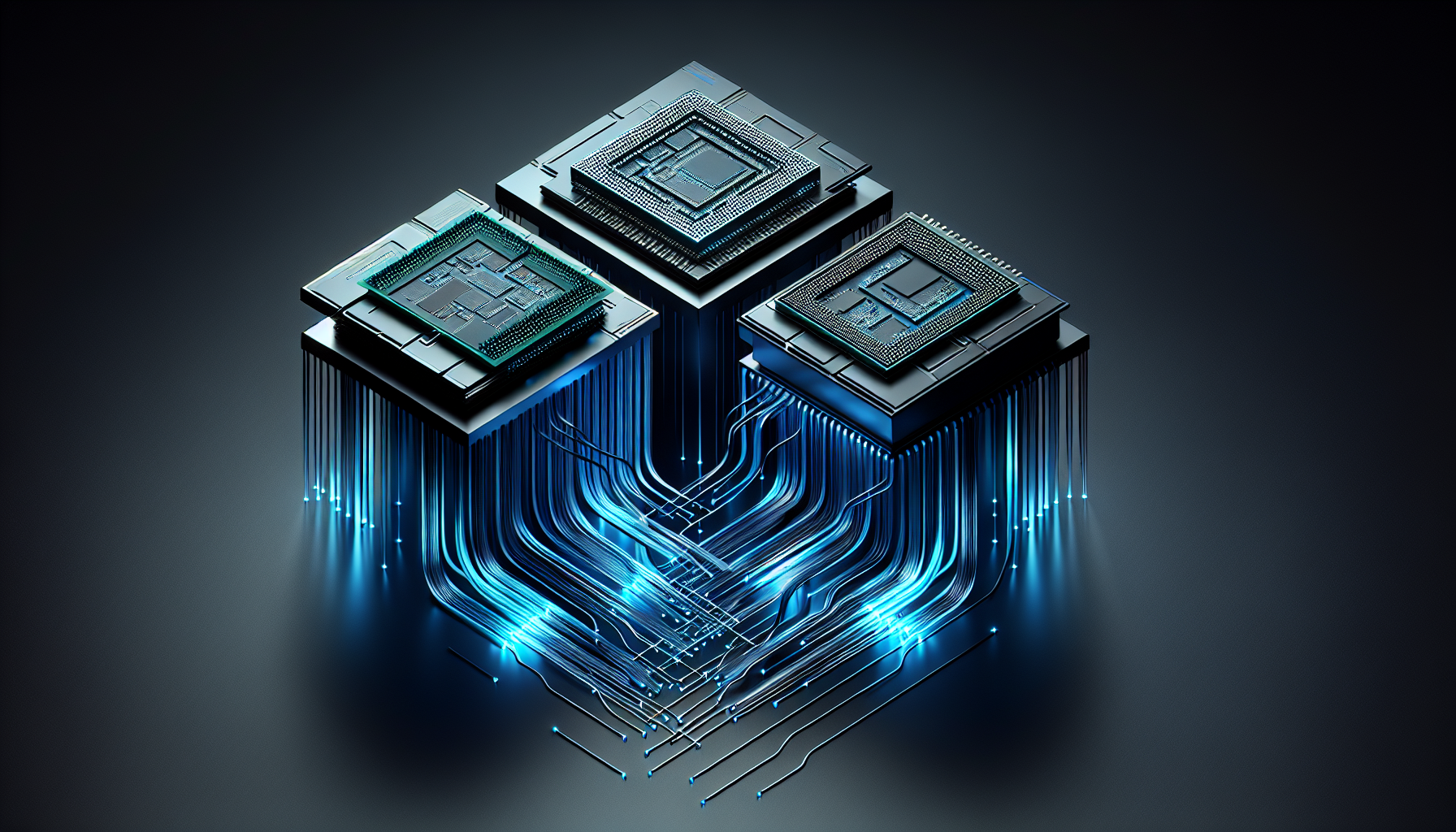
The Architecture Wars: Understanding Processing Unit DNA
The race for AI supremacy isn't just about algorithms anymore—it's fundamentally about choosing the right silicon architecture for the job. According to the latest WindFlash analysis, the performance variations between CPU, GPU, and TPU architectures reveal critical insights that could reshape how developers approach machine learning deployment strategies in 2026.
Central Processing Units remain the workhorses of general-purpose computing, optimized specifically for low-latency operations and sequential task execution. The research indicates that CPUs excel in scenarios requiring complex branching logic and immediate response times, making them indispensable for real-time decision-making applications. Their architecture prioritizes instruction-level parallelism and sophisticated caching mechanisms, enabling them to handle diverse workloads efficiently.
Graphics Processing Units have evolved far beyond their original rendering purpose, emerging as powerhouses for parallel matrix operations that form the backbone of modern machine learning. The data suggests that GPUs demonstrate superior performance in scenarios involving massive parallel computations, particularly in training convolutional neural networks and processing large datasets. Their thousands of cores, while individually less powerful than CPU cores, create unprecedented throughput for mathematically intensive operations.
Tensor Processing Units represent Google's specialized approach to neural network acceleration, featuring systolic array architectures designed exclusively for efficient matrix multiplication. According to the research, TPUs demonstrate remarkable efficiency in neural network training scenarios, offering optimized data flow patterns that minimize memory access bottlenecks inherent in traditional architectures.
Authentication Evolution: PKCE's Security Revolution
The cybersecurity landscape continues evolving with the widespread adoption of Proof Key for Code Exchange (PKCE) protocols, fundamentally changing how applications handle user authentication. The WindFlash report highlights PKCE's critical role in preventing authorization code interception attacks, a vulnerability that has plagued traditional OAuth implementations.
PKCE addresses security concerns by introducing a code verifier and code challenge mechanism that ensures authorization codes cannot be reused maliciously. The research indicates that this approach significantly enhances security for public clients, particularly mobile applications and single-page web applications that cannot securely store client secrets.
Modern authentication patterns show increasing reliance on these enhanced security measures, with data suggesting that organizations implementing PKCE report substantially reduced security incidents related to authorization code theft. The protocol's cryptographic approach creates a unique relationship between the authorization request and token exchange, making intercepted codes useless to potential attackers.
Implementation data reveals that PKCE adoption has accelerated particularly in enterprise environments, where the cost of security breaches continues rising. The research suggests that developers increasingly view PKCE not as an optional enhancement but as a fundamental requirement for production applications handling sensitive user data.
Distributed Tracing: Observability's New Frontier
The complexity of modern distributed systems demands sophisticated observability solutions, with OpenTelemetry Collector emerging as a critical infrastructure component. According to the analysis, distributed tracing has evolved beyond simple request tracking to encompass comprehensive system understanding through integrated telemetry data.
The research details how OpenTelemetry Collector functions as a centralized telemetry processing hub, ingesting data from multiple sources and transforming it into actionable insights. This approach enables development teams to correlate traces, logs, and metrics across microservices architectures, providing unprecedented visibility into system behavior.
Distributed tracing mechanics reveal the intricate dance of data collection and analysis that powers modern observability platforms. The data indicates that organizations implementing comprehensive tracing solutions report significantly improved mean time to resolution for production issues, with some teams achieving over 60% reduction in debugging time.
The integration of telemetry data into unified observability platforms represents a paradigm shift from reactive monitoring to proactive system understanding. Research suggests that this evolution enables development teams to identify performance bottlenecks and optimization opportunities before they impact user experience.
Optimization Strategies: Matching Workloads to Architecture
The architectural differences between processing units translate directly into deployment decisions that can dramatically impact application performance. According to the research, successful AI implementation increasingly depends on workload-architecture alignment rather than simply choosing the most powerful available hardware.
CPU-optimized scenarios include real-time inference applications requiring immediate responses, complex decision trees with irregular branching patterns, and applications where low-latency response times outweigh raw computational throughput. The data suggests that CPUs remain irreplaceable for applications requiring sophisticated control flow and immediate user interaction.
GPU deployments show optimal results in training large neural networks, processing computer vision workloads, and scenarios involving massive parallel computations. Research indicates that GPU utilization becomes particularly effective when batch sizes exceed certain thresholds, enabling the architecture's parallel processing capabilities to demonstrate their full potential.
TPU applications focus primarily on large-scale neural network training and inference scenarios where the specialized systolic array architecture provides maximum efficiency. The analysis suggests that TPUs deliver exceptional performance per watt for specific machine learning workloads, though their specialized nature limits applicability to general-purpose computing tasks.
Industry Implications: The Future of Intelligent Infrastructure
These architectural insights and security developments point toward a future where intelligent workload distribution becomes as critical as the algorithms themselves. The research suggests that successful organizations will increasingly rely on hybrid approaches, leveraging each architecture's strengths while implementing robust security and observability frameworks.
The convergence of specialized processing architectures, enhanced authentication protocols, and comprehensive observability solutions indicates a maturing ecosystem where performance optimization requires holistic system understanding. As AI workloads become more sophisticated and security requirements more stringent, the ability to navigate these architectural choices may determine competitive advantage in the rapidly evolving technology landscape.